There are certain questions that concern all of us whether we take interest in it or not. One such area is satellite communications using satellite spectrum, a space that has engaged the attention of regulators in every country, tracing back to 2001 with the report of European Radiocommunications Committee (ERC) within the European Conference of Postal and Telecommunications Administrations (CEPT). Rich or poor, every country has to address the question of how to manage satellite spectrum and their ways of doing this will show what influences have been at work.
Mukesh Ambani, chairman of Reliance Industries Limited, recently asked what was the reach of Starlink, the Elon Musk promoted company which, along with the Jeff Bezos promoted Kuiper, is entering into the satellite communications space in India. RIL’s question will echo favorably with Airtel and Vi, the other two ‘terrestrial communications’ companies who are interested in getting into the satellite communications space, with the three being seen by the Indian media (and perhaps the Indian people) as pitted against ‘foreign’ companies.
This question is only the latest in this battle of ideas (which will influence the battle for business) that has been shaping up over the last two years or more, ever since the Government of India announced that satellite communications is open to the private sector. Since there are three Indian companies and two foreign companies (so far) competing for what could turn out to be a substantial business, the battle might end up with the colour of ‘us versus them’. It would be unfortunate because what is at stake and issue here is far removed from anything ‘national and foreign’, especially when the Indian Space industry has united against spectrum auction (https://www.medianama.com/2023/12/223-indian-space-industry-spectrum-allocation-auction/).
Spectrum is nothing but airwaves but there are different kinds or waves of different quality, which will enable launch of services. It is the spectrum together with the telecom network technology that facilitates the offering of different kinds of services to consumers – voice, data, radio, TV, other entertainment and so on. The quality of the spectrum is defined in the various soundwaves and airwaves which have a certain frequency and reach. Reach helps in service coverage. What services you can launch and how far is a function of the kind of spectrum. There is an excellent Glossary available at https://nicf.gov.in/wp-content/uploads/2024/08/Glossary-Spectrum-Terms.pdf.
Crux of the battle
The battle is over how interested companies will ‘get’ satellite spectrum. RIL, Airtel and Vi favour auctioning of spectrum, while Starlink and Kuiper argue in favour of administrative allocation and pricing. Framed this way, the picture is incomplete.
Two things happen in an auction: companies bid for a certain frequency band or certain frequency bands quoting a price for a band. If they won the bid, it is at a certain price and they get ownership of the band. Typically, an auction is seen as a price discovery mechanism. In administrative allocation, the Government decides, on certain logical foundations, to assign spectrum to various users, taking into account many factors including reach.
Now, you can see that it is not just a battle between two different methods of allocating spectrum but more a question of control. That’s the battle. The successful bidder in an auction gets the right of exclusive use of that frequency band, which is challenged by those in favour of administrative allocation.
Why? For a simple reason. Administrative allocation entails spectrum sharing, exactly the opposite of exclusive use, but leaves open the question of how price is fixed, for which, there is more than one approach.
The rest of the article will deal with these themes: right to exclusive use Vs spectrum sharing and the most efficient way to determine pricing of spectrum (in administrative allocation). First, let us note an important fact: satellite spectrum is limited compared to terrestrial spectrum. There are many technical dimensions involved in satellite spectrum (any spectrum actually) because there are many frequency bands, but I am steering clear off them to focus on core issues.
Exclusive use Vs spectrum sharing
In a paper titled ‘Principle of spectrum sharing’ in September, 2023, The Brattle Group expresses the point in an extremely sharp manner: “The right to use radio spectrum is a collection or a bundle of different rights” – https://spectrumfuture.com/wp-content/uploads/2023/09/Principles-of-Spectrum-Sharing-Understanding-the-Value-of-Shared-Spectrum.pdf. They are in illustrious company because the argument was made in 1960 by Ronald Coase, an economist with a theorem named after him (the famous Coase theorem), that property should be seen as a bundle of rights: “what a landowner in fact possesses is the right to carry out a circumscribed list of actions” – The Problem of Social Cost – https://www.sfu.ca/~wainwrig/Econ400/coase-socialcost.pdf.
This is a foundational insight as this way of viewing a resource, any resource, makes a profound change not just to pricing but expectations of the way any national resource must be allocated and used. The right is not of ownership but to use, which inherently comes with responsibility, otherwise absent in ownership and will have to be imposed from without. The opening sentence in Coase’s essay is crystal clear: “This paper is concerned with those actions of business firms which have harmful effects on others”.
The Satcom and the Space industries
In an article titled ‘Why satellite spectrum requires non-exclusive assignment approach’, Anil Prakash, DG SIA India, May 16, 2023, explains why the industry is against auction and therefore right to exclusive use, which, while it “may maximise revenue for the exchequer, (it) could lead to fragmentation resulting in a loss of satellite capacity. It would potentially create monopolistic competition with deep-pocketed players, creating an anti-competitive environment Moreover, such an approach may prevent rural/unconnected users, startups, micro, small and medium enterprises (MSMEs), and various socioeconomic sectors such as disaster management, agriculture, healthcare, education, transportation, energy and others from accessing the necessary spectrum for their operations” – (https://tele.net.in/why-satellite-spectrum-requires-non-exclusive-assignment-approach/).
He refers to a 1995 Supreme Court judgment in a broadcasting case where a three-judge bench pronounced that “The airwaves or frequencies are a public property. Their use has to be controlled and regulated by a public authority in the interests of the public and to prevent the invasion of their rights. Since, the electronic media involves the use of the airwaves, this factor creates an in-built restriction on its use as in the case of any other public property.” (URL as above)
There is also a battle between the Department of Telecommunications and TRAI on the question of auction with TRAI concerned with the most efficient and optimal use of spectrum. TRAI was asked in 2021 by DoT to make recommendations which have been delayed because according to media reports DoT did not furnish TRAI with complete technical data but TRAI has recently announced that it “is working to submit a recommendation on satcom spectrum assignment by December 15. There were several points raised during the open house discussion, some of which were beyond the consultation paper. Those points also need to be looked upon”, an official told the media on condition of anonymity (November 11, 2024) – (https://www.business-standard.com/industry/news/trai-to-finalise-satcom-spectrum-allocation-norm-suggestions-by-dec-15-124111101527_1.html).
Taking a legal angle, especially constitutional law, Abhishek Malhotra (September 22, 2023), in a detailed article, asks: Satellite Spectrum Allocation – Is Auction the Legal Mandate? (https://www.sia-india.com/corner/satellite-spectrum-allocation-is-auction-the-legal-mandate/) He refers us to Article 39(b) of the Indian Constitution which require adoption of all methods of distribution that cater to the common good and Article 14, which is on equality: “While every State action, including distribution of largesse, grant of contracts, etc., is to be tested on the touchstone of Article 14, auction as a method of disposal of natural resource cannot be held as a constitutional mandate as it cannot be applied absolutely in all circumstances”. The closing phrase of the sentence is vital.
Malhotra says that in April 2012, “a Presidential reference was made to opine on the 2G Case as the issues involved far reaching implications, raising questions of law of grave public importance. One of the key issues in the Reference was ‘whether conducting auction was the only permissible method for disposal of all natural resources across all sectors’”. To Malhotra, the answer is in the negative.
The emerging Space industry in India has also weighed in against exclusive use through auction. Other than the SIA, referred to earlier, there are two bodies – Indian Space Association (ISpA), and Global Satellite Operators Association (GSOA). Ever since the privatisation of space began, we have seen the emergence of Indian aerospace startups such as Dhruva Space and Xovian Aerospace. Dhruva Space has argued that none of the frequency bands should be assigned exclusively in favour of a single player – (https://www.medianama.com/2023/12/223-indian-space-industry-spectrum-allocation-auction/).
Risk of idle spectrum
The argument against monopolistic competition, which will result from auction, is an argument against inefficient use. Successful bidders with deep pockets may just sit on spectrum once acquired (or cornered), instead of deploying services, which means the spectrum remains idle.
Global Satellite Operators Association (GSOA) mentions that there is a need for some minimum eligibility criteria for administrative assignment” to deter speculative application (https://www.medianama.com/2023/12/223-indian-space-industry-spectrum-allocation-auction/). According to them, stringent criteria have to be used such as insisting that the applicant should hold a unified license (UL) and should be able to demonstrate its compliance with the ITU [International Telecommunication Union] Radio Regulations. Thus, one of the objectives of the policy on satellite spectrum is to ensure against spectrum made to remain idle.
This is a serious point. During the license raj, idle capacity was very common; many leading business groups procured industrial licenses and kept them idle – it had served its purpose of keeping the competition away. Students of Indian economy at undergraduate level know this! A company’s financial clout to acquire spectrum does not come with the right to keep it idle, especially when satellite spectrum is limited. Recall the opening sentence of Ronald Coase’s essay on why property should be treated as a bundle of rights.
Spectrum sharing
Core to administrative assignment of spectrum is that it be shared. Sharing of infrastructure is nothing new. In the United States of America, railways were privately owned and operated in the early stages and the tracks were used as common resources. Air space and airports, water and seaports and the good old roads are all examples of successful use as shared infrastructure with a pricing mechanism based on many relevant factors.
The argument against auction is an argument in favour of sharing, with administrative allocation and its corollary pricing the mechanism to implement sharing. It is important to remember this point lest it be misconstrued as a choice between auction and administrative allocation, and mis-portrayed as a choice between market and bureaucracy.
According to the SIA, TRAI itself has acknowledged that three countries have tried a form of competitive allocation in connection with some satellite orbital resources (Brazil, Mexico, and the United States) but all three have abandoned it in favour of administrative allocation (https://www.medianama.com/2023/12/223-indian-space-industry-spectrum-allocation-auction/). Space startups don’t visualise any technical hitches to spectrum sharing.
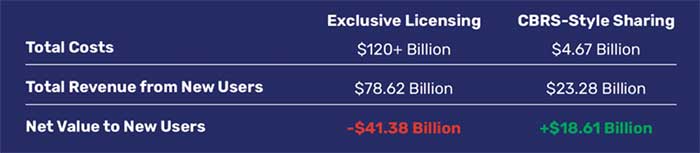
According to Dhruva Space “There is adequately established precedence that multiple satellite systems can co-exist in the same frequency band in a coordinated manner, as per the [International Telecommunication Union’s] Radio Regulations”. A new study by Brattle Group says that, “in the 3.1-3.45 GHz range, a shared approach can create almost $19 billion in net private value, while exclusive licensing would impose a net loss”,
(https://spectrumfuture.com/new-study-spectrum-sharing-key-to-maximizing-value/).
Administrative pricing
The European Radiocommunications Committee in its 2001 report observed that “many different factors that are taken into account, which may include technical elements, elements related to the type of service, administrative elements and elements related to the size of the system. Furthermore there are one-off fees, yearly or monthly fees charged for administration, spectrum, control and enforcement and, in some cases, for electromagnetic compatibility”.
Administrative pricing is going to be a fiercely contested terrain, with what technical and economic aspects to include and exclude. And we can see a divide emerging between the new space business and satellite communications operators. GSOA argues that the government should focus on recovering administrative costs and even waive off spectrum usage charges “since this spectrum is used primarily for connecting the unconnected.” It is doubtful if the GoI will waive off usage charges. In a news article titled ‘Government may be on target on telecom revenues despite weak auction’, The Economic Times says that “As per estimates, Rs 16,000-20,000 crore is expected to come from past auction dues and another Rs 40,000-50,000 crore from spectrum usage charges (SUC) and licence fee. BSNL is likely to pay around Rs 60,000 crore as spectrum dues for 5G airwaves in 700 MHz and 3300 MHz band” – https://economictimes.indiatimes.com/industry/telecom/government-may-be-on-target-on-telecom-revenues-despite-weak-auction/articleshow/111439943.cms?utm_source=contentofinterest&utm_medium=text&utm_campaign=cppst.
Determining administrative cost
The UK-based Plum Consulting has studied the subject and published a report which can be accessed at https://www.ppiaf.org/sites/default/files/documents/2021-01/Spectrum_pricing_and_fees_v03_PLUM_REVISED_FEB22_clean.pdf. Right at the start of the report, it announces loud and clear that “the main economic objective of spectrum management is to ensure efficient allocation and use of spectrum to maximise benefits to society”, because radio spectrum is a national resource, as we have already mentioned. Pricing is a mechanism to achieve this outcome. In sum, spectrum sharing & pricing are not important in themselves but only as a means to maximise the benefits to society. Guidelines on policy should be based on this foundational principle.
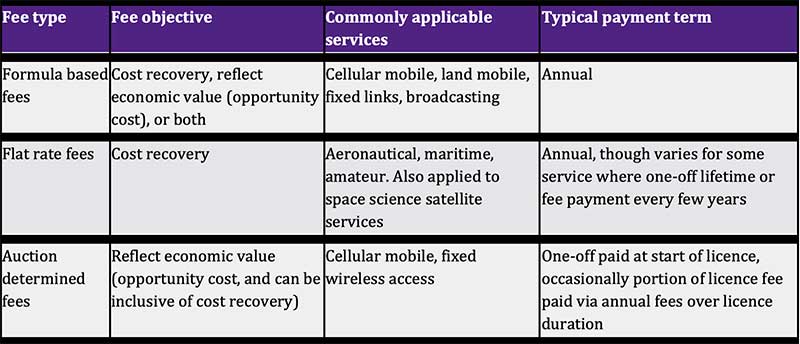
There can be different methods of calculating price but they should address two basic dimensions: cost of spectrum management (usually referred to as cost recovery) and reflect economic value in the sense that it should yield the most efficient use of spectrum. There are many frequency bands and their usage is unlikely to be uniform; efficiency in use of assigned spectrum should focus on areas where there is currently excess demand or likely to be in the foreseeable future. This will ensure that the spectrum is actually used.
Consider the power sector where a two-part tariff has been operative for many years. One fixed part focuses on recovery of all costs associated with the base load below which the power plant cannot operate and the variable part charges the user based on consumption. Variations of this well-entrenched model can be made adapting to the greater technical dimensions involved in spectrum.
Plum has captured the possibilities in a table.
Conclusion
A few days ago, Plum analysed Starlink’s satellite communications system in detail and has published a report accessible at https://plumconsulting.co.uk/the-real-price-of-satellite-connectivity-a-global-analysis-of-starlinks-affordability/.
It is based on data gathered from several countries where Starlink operates and makes the crucial point that their pricing is not just based on cost but also adapts to local conditions, which, by definition, vary significantly. In their conclusion, they ask: “Can satellite-based solutions like Starlink ever be affordable enough to be the primary tool for digital inclusion or will they remain a premium option, accessible only to a small segment of the population?”
This entire debate involving multiple technical and economic dimensions makes it abundantly clear that while a decision has to be made between auction and allocation, the responsibility of the Government does not end with the policy choice. In fact, it begins as, whichever way the Government of India leans towards, it will have a deep and long-lasting impact. Hence, there is great need for wise counsel, which should stay clear of the ‘national Vs foreign’ slogan camouflaged as a framework.
It must be thought through the lens of digital inclusion which has been a slogan for quite a few years. GoI must keep asking itself why we are doing this, what do we want to achieve and what is the most efficient means of achieving the targeted goals. There must be milestones to ensure that we are moving towards stated goals supported by a monitoring mechanism. It is easy to get lost in technicalities and there will be acrimony but the government has to stay firm and focus only on one question: ‘Why satellite communications?’