The curriculum offered in Development studies produces neither knowledge nor skills. The recent outburst over the unemployability of MBA students could well have been about students of development studies too
Interestingly, according to the latest India Skills Report, MBAs are no longer employer because they lack the requisite skills. While part of the problem is the rampant mushrooming of institutions offering some form of MBA, academics have called for a complete overhaul of the curriculum. Readers may recall that this discussion has already taken place in engineering, most of who were considered unemployable by captains of the Indian IT industry, the main source of employment for such students. The more important point comes from Dr Girdhari Lal Tayal, dean, academics, Indian School of Business and Finance (ISBF) (who) believes that for MBA, it’s all about timing. “Timing an MBA is highly essential, with or without pandemic or economic slump. One should do it once one has developed the business and emotional maturity needed to lead teams,” he said (https://indianexpress.com/article/education/mbas-not-employable-academicians-demand-curriculum-overhaul-7195130/). The curriculum offered should also be appropriate to such students and not what is currently offered.
Anyone who has taken a careful look at the structure of the curriculum in Masters in Development Studies will immediately notice there are several independent themes put together as development curriculum. Unfortunately, some of them are highly specialized subjects and hence must be treated at a certain level of depth and detail to offer any insight at all, which is not possible in an effectively ten and half months course. The unfortunate result is that students acquire neither knowledge nor skills. Yes, this is true of a large number of MBA students as well but that is no consolation. Academic institutions tend to look down upon professional degrees such as the CFA – Chartered Financial Analyst – which equips students to work in the investment business. The focus is on building concrete skills directly relevant to the business of investing such as calculating cash flows, returns on investment, profitability of investment, evaluating company performance, and so on. The course combines conceptual rigour with skills in calculating various measures.
Let me mention two ‘themes’ – anthropology and social justice, the first dealing with, among other things, the aspect of caste and various peoples who come under the SC/ST, OBC categories as defined by GoI. The problem in India is not just caste but a whole world of sub-castes, each of who is claiming to be marginalized and hence deserving of reservation. This is not just between states but within them. And even in certain small states with a population in the low tens of lakhs, the population is deeply divided among several tribes and communities, living together in uneasy co-existence, the equilibrium so fragile that it takes just a minor incident to disrupt it.
The problem is not caste but its misuse by politicians, which, in a parliamentary democracy is all about winning elections. Anthropology doesn’t prepare you for facing this. In a fundamental sense, the unending conflict is easy to understand, if you compared the intensity of the debate before and after 1991, when the process of economic reforms was set in motion. As the economy opened up and opportunities to profitably engage with it also increased, the size of pie became visible and thus became an incentive to fight more for a larger share of a growing pie. The politicization has reached such levels that even powerful castes have begun clamouring for reservation. Many mistakenly thought that economic growth will dampen such conflicts but has in fact intensified it. It is not that growth is inadequate to the demands of the population or that it is not evenly distributed but simply that it is such an appealing area to politicize. No politician is going to forego such opportunities. How does anthropology help understand this? Why not teach the politics of resources use?
Or social justice which is influenced by how people react to others apart from how the government, semi-government machinery or any institution deals with people. Consider the problem of people from certain communities – religious and others – who could not find accommodation in some places, a denial of justice. As we see, this is leading to greater and greater ghettoization. Or the ‘honour killings’ which have gone unabated with now ‘love jihad’ an unnecessary and unwelcome addition. These are real problems that call for real, feasible solutions. Instead we have academic studies on identity politics!
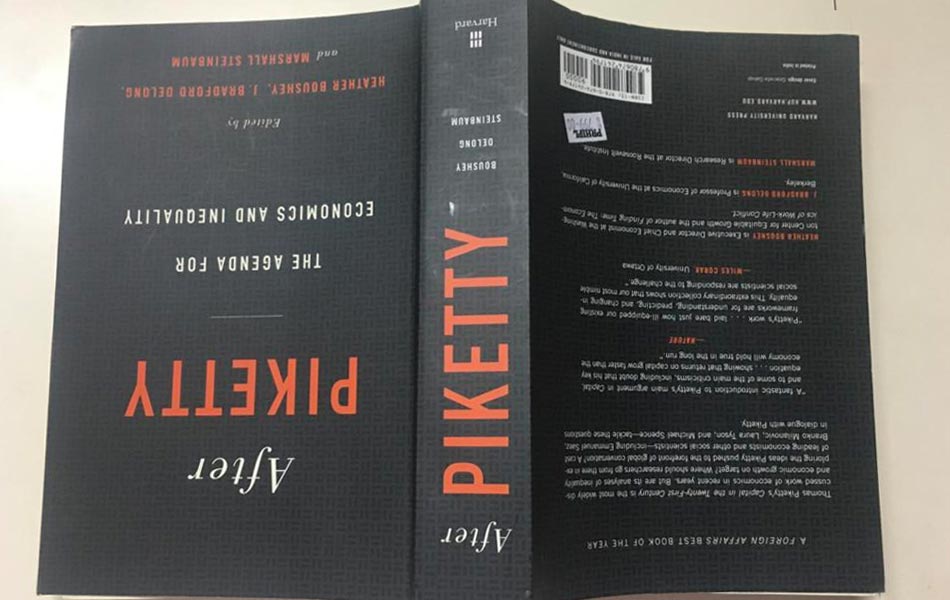
Let me end this with a theme that is at the heart of any study of development: inequality. Three economists – Thomas Blanchet, PhD candidate at the Paris School of Economics, Lucas Chance, Co-Director, World Inequality Lab at the Paris School of Economics and Amory Gethin, Research Fellow, World Inequality Lab – observe that “Yet, the existing academic literature has so far struggled to reconcile inequality estimates with macroeconomic growth figures. Recent studies have made significant advances in this direction by combining surveys, tax microfiles, and national accounts for the US (Piketty et al. 2018) and France (Garbinti et al. 2018), but the question of the long-run evolution of income disparities in Europe as a whole remains insufficiently understood” (https://voxeu.org/article/forty-years-inequality-europe). They do not stop here. Identifying what they consider biases in data collection, they propose a new methodology. They have an excellent paper on the subject examining 38 countries in Europe which is available at https://wid.world/document/bcg2019-full-paper/. There have been extensive discussions on Picketty’s approach to measurement and treatment of inequality which is good because it has brought the subject to the fore.
The future of development studies probably lies in developing such skills that help improve clarity on what needs to be measured and how. And today, we have the resources to undertake such a task. Yes, it will call for a different set of skills: basic concepts and their relevance and appropriate measures that will drive new policies or help critique existing policies from a strong foundation of sound and well-calculated metrics. Perhaps, it is time to recognize that development should cease to be an academic study and be redefined and restructured as a professional study. An entirely different curriculum should be designed to meet the demands of working in and with the development sector.
There is one sub-subject of economics that is directly relevant to the study of development, which will also fit in with a professionalization of the curriculum: public finance. However, it is debatable whether everyone needs a deep and detailed study of public finance, the level being linked to what a person wishes to do in the development sector. Perhaps, we can have two different courses – professional and academic, with the academic focusing on public finance. We will keep an open mind and keep exploring. While this is a matter of curriculum design, we explore the subject of public finance and its relevance to the study of development.
Takeaways
Employability should be a criterion to judge the quality of curriculum
Some work experience prior to development studies is advisable
Skills in measurement using multiple sources of data is a requisite skill
Professionalization of curriculum is the way to go ahead
Understanding of public finance is mandatory