The fascination with and growing business in AI brings fortunes for copper and rare metals (with ominous geopolitical repercussions) as well as data centres, without which nothing in IT and software is possible. While one part of the world is in raptures over something called AI, another part is merrily cashing in on emerging business opportunities.
The physical is inescapable, as it accompanies, like the unshakeable shadow, the cloud, digital and so-called AI, bringing us down from the stratospheric universe. It is important to emphasise this earthiness because it forces a grounded view of every tech ‘euphoria’ that global media keeps hyping up. This euphoria keeps getting orchestrated across diverse areas including life-sensitive areas such as neurodegenerative diseases like Alzhymer’s and dementia and of course cancer. Remember Edmund Burke – Eternal vigilance is the price of liberty.
Ever since the obsession with the digital and AI, this one-sided approach has deepened and become pervasive, which is ironic when seen against the background of constant calls for a 360 degree thinking or holistic approach! A mundane discipline like double-entry book-keeping has formally incorporated it by looking at equal and opposite sides of every transaction, a truth revealed by Newton’s third law of motion!
Copper and others
Precious metals have always been key components in chips, including AI chips, the widespread adoption of AI has allowed copper to become more important. Trafigura, a commodity trader, has said that AI could add 1 million tons to copper demand by 2030. “If you look at the demand that is coming from data centers and related to that from AI, that growth has suddenly exploded,” said Saad Rahim, Trafigura’s chief economist, at the Financial Times Global Commodities Summit in Lausanne. https://www.reuters.com/markets/commodities/ai-could-add-1-million-tons-copper-demand-by-2030-says-trafigura-2024-04-08/. Chile, Peru, the Democratic Republic of Congo, China and the USA are the top five copper producing countries https://en.wikipedia.org/wiki/List_of_countries_by_copper_production. It is not just copper but rare metals too which are seeing a spurt in demand.
In this graph, Jürgen Riedel presents demand for rare metals (neodymium, cerium, and praseodymium) “with Australia and China being major suppliers”. (https://www.linkedin.com/pulse/rising-tide-ai-computing-chips-demand-rare-earth-metals-j%C3%BCrgen-riedel-4nbhe/). The geopolitical significance of this simply ominous.
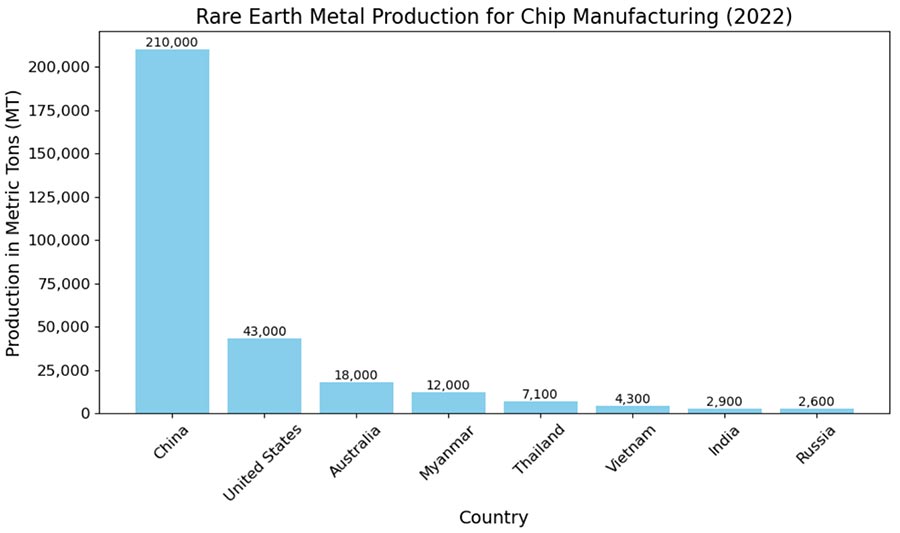
Quoting Metals Focus, a metals research agency, Reuters reports that “growth for AI servers and switches will rise by double digits over the next few years and stimulate precious metals demand”, such as platinum alloys used in chip manufacturing, silver-palladium Ag-Pd multi-layer ceramic capacitors in high power components, gold bonding wire in chip and memory packages, gold plating in printed circuit boards and palladium plating on lead frames, (https://www.reuters.com/markets/commodities/ai-boom-could-feed-precious-metals-demand-metals-focus-2023-10-25/). This is what Economics defines as ‘derived demand’.
The physical infrastructure for AI – data centres
Many Indian business groups including Adani, Reliance and international groups like Amazon have announced plans to invest billions of dollars in building data centres, echoing the trend in warehouse construction in response to the growth of ecommerce – https://www.challengingintelligence.com/management-innovation/the-physical-transformation/. A Bloomberg story reports that Amazon.com plans to spend $150 billion in the next 15 years to respond to the growing demand arising out of cloud, digital and AI and also to establish a strong competitive position against both Google and Microsoft https://www.bloomberg.com/news/articles/2024-03-28/amazon-bets-150-billion-on-data-centers-required-for-ai-boom.
Let us take stock of what goes into setting up data centres, besides cement, steel and glass. Cisco’s primer puts this in perspective: “At its simplest, a data center is a physical facility that organizations use to house their critical applications and data. A data center’s design is based on a network of computing and storage resources that enable the delivery of shared applications and data. The key components of a data center design include routers, switches, firewalls, storage systems, servers, and application-delivery controllers” https://www.cisco.com/c/en/us/solutions/data-center-virtualization/what-is-a-data-center.html.
Data centres continue to evolve with every development in the businesses they support, but also initiate change such as was the case with the development of software defined data centres. The rising influence of software in running datacentres and even telecom networks, where it was called software defined networks (SDN), has underlined the need to find the right balance between the hardware and software, which has now acquired a sense of urgency, because of the pace at which demand for such contemporary data centres is growing.
So, what is new?
Data centres that will facilitate ‘AI’ represent a different opportunity for real estate developers and contractors because of their specialised nature, according JLL, a global real estate services firm, in its report Data Centers 2024 Global Outlook. It claims that designing and building such data centres has to be linked to “the type of data processed or stage of generative AI development”. These centres will generate more heat than ‘normal’ data centres, underlining the vital role of cooling, which uses approximately 40% of an average data centre’s electricity use. JLL sees operators “shifting from traditional air-based cooling methods to liquid cooling”. (https://www.us.jll.com/en/newsroom/growth-of-ai-creates-unprecedented-demand-for-global-data-centers)
According to several media reports, Google is combining purpose-built hardware with an optimized software stack to improve data centres’ efficiency and Microsoft has their first dedicated AI chips and server CPUs, while also announcing new rack designs with accompanying cooling systems. Incidentally, how is this different from ASICs?
When cloud computing was becoming the norm, data centres were marketed as ‘cloud ready’. A similar phenomenon is going to get unleashed with ‘AI ready’ data centres, making data centres an exciting business, just as tunnelling became an attractive and fashionable business with the export and import of LNG.
While jobs involving writing and summarising may be threatened, there will be growth in metals exploration, mining and extraction, chip design, data centre design, cooling systems, modular furniture, and a whole army of support services. The impact will be uneven but not one-sided; it is time grounded thinking displaced uninformed fascination.