While the universe is agog with hype about the unlimited potential of AI and digital transformation, good old IT projects are a constant reminder that reality is often at odds with such ‘fantastic’ picture – they continue to fail more than 40 years since the origin and growth of software (including operating system) as a separately sold product. Perhaps, the ‘legendary’ powers of AI can be brought to bear on such a pedestrian problem!
There is nothing like a dose of reality to bring people to senses, although if wilful ignorance holds away, as it often does, the fantastic continues to win. There is an overwhelming and overpowering atmosphere of AI – how AI can solve climate change, cancer, Alzheimer’s, chip-making and so on. There is nothing that cannot be addressed, managed and solved by AI. To repeat what I have told my students, when an idea has become a ‘fantastic’ giant, direct confrontation is unlikely to make a dent. You have to say something else which might reflect on the credibility of the fantasy.
Continuing story of tech failures
A 2024 study by BCG shows that “more than two-thirds of large-scale tech programs are not expected to be delivered on time, within budget, or within their defined scope’, listing factors such as ‘ineffective management of interdependencies’ and ‘poor tech-business collaboration’ as the principal among many other reasons for this sorry state of affairs. The pity is that these were reasons you could finds in similar studies of 30 years ago. According to AvenData, “up to 85% of these projects fail, which seems astronomical. In contrast to other industries, developing information technology solutions has not decreased its failure rate over the past 20 years” (https://www.linkedin.com/pulse/most-projects-fail-75-fall-short-goals-avendatagroup/).
The sordid state of affairs is not confined to any one country. German analysts, quoted in the above study, observe that more than half the IT projects fail. Europe as a whole is no exception to the problem of IT failures.
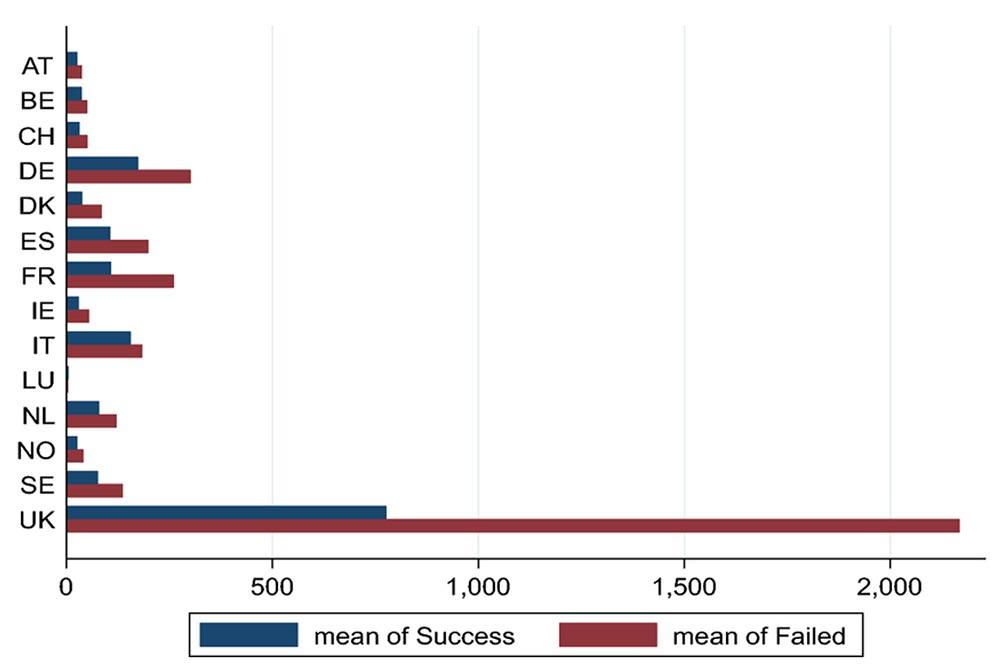
Figure – available from: Journal of Cultural Economics
Number of successful and failed projects by country and year. Note This figure displays the mean of success and failed of campaigns launched on Kickstarter between 2015 and 2019 in cultural and creative categories in the following 14 European countries: Austria (AT), Belgium (BE), Switzerland (CH), Germany (DE), Denmark (DK), Spain (ES), France (FR), the United Kingdom (UK), Ireland (IE), Italy (IT), Luxembourg (LU), Netherlands (NL), Norway (NO), and Sweden (SE).(https://www.researchgate.net/figure/Number-of-successful-and-failed-projects-by-country-and-year-Note-This-figure-displays_fig2_361402703).
Change & Changed approach, and yet
In the world of IT, change often also means continuing with what is old, otherwise known as legacy systems, one of the worst, throbbing headaches, because its architecture and risk management system cost a lot to operate and support. As a study by the German tech magazine Computerwoche.de shows, “the old systems need more care. In 59 percent of companies, the effort required for the maintenance and operation of existing systems is significantly higher, higher or rather higher compared to other applications” https://www.computerwoche.de/article/2813980/it-steinzeit-in-deutschen-firmen.html. One of the reasons for this is that the skills required for such systems are difficult to access.
Another story in the tech magazine CIO says that despite changes in approach, IT projects continue to fail. The silver lining, according to CIO, is that such failures don’t bring the whole IT department down. “Today, with the advances in agile, the definition of ‘failure’ has morphed,” says Te Wu, CEO and chief project officer of PMO Advisory, an associate professor at Montclair State University, and a Project Management Professional (PMP) who also serves as co-chair of the Project Management Institute’s development team on the portfolio management standard – https://www.cio.com/article/230427/why-it-projects-still-fail.html.
While it is tempting to think of this as some consolation, here is the dampener: “According to KPMG’s 2023 Technology Survey, 51% of the responding 400 US technology executives said they have seen no increase in performance or profitability from their digital transformation investments in the past two years” (URL as above). If you thought surveys could be misleading, here is a list of five of the biggest IT failures – Sainsbury’s warehouse automation, Apple’s Copland operating system, FozMeyer’s ERP project, Nest’s software refresh (Google-powered smart thermostat) and the US Census’ remote devices – https://www.ratcliff.it/news/5-famous-it-project-failures-and-how-you-can-avoid-their-pitfalls.
FozMeyer’s ERP failure is revealing because it brought the company down! And the US Census was a $600 million failure! In a provocatively titled article Why Your IT Project May Be Riskier Than You Think, Harvard Business Review (September 2011), Bent Flyvbjerg and Alexander Budzier, detail how mismanaged IT projects cost hundreds of millions of dollars through abject failure and cost overruns which cross 200% in certain cases and have brought down companies – https://hbr.org/2011/09/why-your-it-project-may-be-riskier-than-you-think.
CHAOS
The annual CHAOS report of the Standish Group International, presents a discouraging picture, published since 1995, with a database of over 50,000 projects. It chronicles the failure of most IT projects to achieve scope, timing, budget and quality goals (all four). As of their 2020 “CHAOS Report: Beyond Infinity,” only 19% of all IT projects achieve these four lofty goals, which has not gotten much better in the past 40 years and, frankly, may even be worse. Many projects will, of course, achieve a combination of some subset of these goals, e.g., timing and quality but not scope and budget – https://pubsonline.informs.org/do/10.1287/LYTX.2024.01.10/full/.
The first CHAOS report said that only 16.2% of IT projects succeeded, with success rising to 35% by 2006 – https://www.cliffsnotes.com/study-notes/20160170. The top five reasons, according to this study, are: lack of user input, technical incompetence, incomplete requirements or changing requirements and specification as well as lack of executive support – (URL as above).
The Preface to the report says that “a staggering 31.1% of projects will be cancelled before they ever get completed. Further results indicate 52.7% of projects will cost 189% of their original estimates. The lost opportunity costs are not measurable, but could easily be in the trillions of dollars”, going by just one example of the City of Denver: $1.1 million per day, the cost of failure to produce reliable software to handle baggage at the new Denver airport (https://www.csus.edu/indiv/v/velianitis/161/chaosreport.pdf).
Not just IT
Unfortunately, the problems are not confined to IT projects but extend to any big project. A study found that EU spent €440 million on failed gas projects since 2013. We will confront this topic in a later article.
Chronicling such continuing failures is not being cynical or gloating but merely to underline the simple truth that a fascination with technology without its corollary enabling structure and system is forever doomed to fail.