In this second part, I look at the claims made for the utility of business model.
Let us start with an arresting beginning: “Strategy has been the primary building block of competitiveness over the past three decades, but in the future, the quest for sustainable advantage may well begin with the business model”. This is the opening sentence of “How to Design a Winning Business Model”, by Ramon Casadesus-Masanell, professor at Harvard Business School and Joan E. Ricart, the Carl Schroder Professor of Strategic Management and Economics at IESE Business School in Barcelona, in HBR (January-February 2011). The concept of business model suffered a fate along with the collapse of the dotcom boom but lingered enough to be salvaged by some writer or the other. Even in 2002, there were articles emphasizing the importance of business model as a means of understanding what holds businesses. Both strategy and business model can be used as keys to opening up a more efficient way of thinking about businesses. If people don’t get caught up in turf battles, both can help open up a space of thinking.
First the basics. Writing “Why Business Models Matter,” in 2002, Joan Magretta, comes to the point. “A good business model answers Peter Drucker’s age-old questions, ‘Who is the customer? And what does the customer value?’ It also answers the fundamental questions every manager must ask: “How do we make money in this business? What is the underlying economic logic that explains how we can deliver value to customers at an appropriate cost?” Concepts that have a practical bearing must be evaluated on the outcomes they can influence. While a business model has more to do with how best to earn revenue, the other questions ensure that the choice of the model is in sync with the rest. Everything has to jell together. In the app economy, most app developers resorted to selling through others who had a captive audience – Apple, Google, Microsoft. The narratives on these shaping the revenue sharing model that finally became the norm is an example of what a business model is and what it can do. It is useful to bear in mind that you need to be sure that you have a viable product or business before you start thinking on an appropriate business model. In this instance, you need to ask whether the app will sell at all first before debating what is the best way to sell.
It is tempting to thinking of a business model as essentially a way of earning revenue but there are caveats. At the dawn of the internet and the boom it launched into frenzied motion, what was made available came free raising the question of how the business was going to earn any revenue. Turned out that the business itself was defined as something else – the traffic or the information gathered that was of use to someone. Even payment systems in the early stages didn’t charge for any transaction fee hoping to create a business out of the kinds of customers and their use of the system just as websites began monitoring specific page views to sell to advertisers. In instances, the critical question is not so much about the business model per se but the business itself. In ‘What is a business model?’ (January 23, 2015), Andrea Ovans refers to Michael Lewis book The New, New Thing, where he called business model ‘a term of art’, going on to say that “The business model of most Internet companies was to attract huge crowds of people to a Web site, and then sell others the chance to advertise products to the crowds. It was still not clear that the model made sense”. What Lewis forgot to note was that this was how most firms thought of business. As far as I can recall, Yahoo charged a transaction fee since the beginning such that it made profits right since inception.
Take newspapers (and magazines) today. Condemned to offering their content free, they trudged along for years before deciding to wrest control back (perhaps at a cost) by erecting paywalls together with allowing a certain number of free articles a month. Many frontline newspapers and magazines in India have embraced this strategy but this comes with a challenge: how to convert a ‘free customer’ into a paying customers. Typically, customers will look for alternative ways of gathering the ‘same’ information (or at least what they think is the same) if they confront a paywall. Those who have embraced this approach must realise that they need to offer ‘must read’ content without which this model will not succeed. Wall Street Journal charged a few for its online version since it went online. And succeeded.
Rather than get caught in theoretical or definitional orientations, we need to always bear in mind the difference between business (or rather the product) and ways in which revenues can be earned. Take the way mobile phones are ‘sold’ in the US. Until a few years ago, people ‘bought’ mobile phone through the service they subscribed to with their telecom service provider. It was Sprint which made a part of its sales ‘open’ in the sense that it began allowing subscribers to bring their own phones, thus employing two business models. Or Dell opening retail outlets. Both recognized (as must have many others) that their assumptions were no longer valid and hence they must change to be in sync with the changed environment.
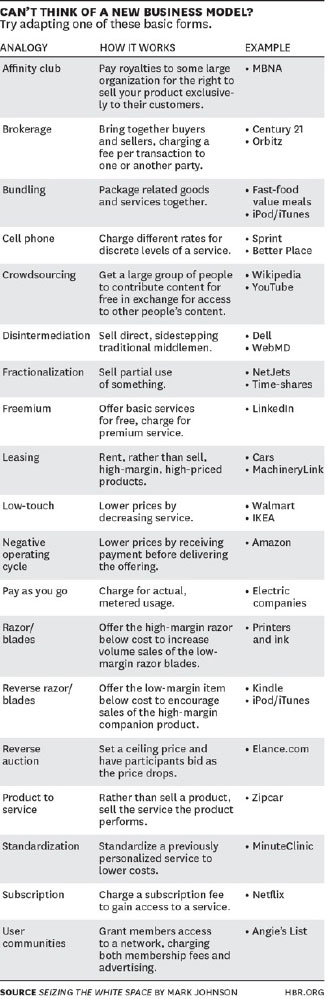 Many have written on business model because it is an attractive way to examine what is a business and how it operates, and it is possible to go astray and get caught in frameworks. They have identified various dimensions that go into making a business model such as cost, channels, partners, customers and their segments. You will see here a table of possible business models. I leave it to you to judge.
We can keep expanding the list but we may end up missing the point that Drucker keeps reminding us of: assumptions and their environments. The advantage of heeding Drucker’s advice is it keeps the focus simple and sharp: delving into a business’ underpinnings, its value creators and vulnerabilities, its risks from within and without the segment to which it (currently) belongs, changes being made by others affecting its offerings (product or service or product as service). Perhaps, I am biased but I find Drucker simple and piercing. Simple but powerful thinking.
Takeaways
Much of what is claimed for business model could be just strategy
Business model seems just a way of saying how the business runs
Drucker
You can read part 1, 3 and 4 of this article by clicking on the buttons below: